

Homily - All Souls - 2025
Joh 6:37-40
Is 25:6.7-9
Phil 3:20-21
focus: We have to pray for our deceased that they may fully arrive home in heaven. At the same time, we are reminded of the shortness of our own lives.
Preschooler Corey’s beloved Grandma had died. He often talked about his Grandma and all the wonderful things she had done with his Grandpa when picked him up from school in the small Iowa town where he lived. And grandpa said: She has gone to heaven. One day, someone else picked Corey up from school. The next day when Grandpa came for him again, he asked, “Where were you yesterday, Grandpa?” “I went to Nebraska, to the grave, to visit Grandma,” he replied. Corey’s response was swift, “Grandpa, I didn’t know heaven is in Nebraska!” When we die, we go to heaven. Corey had learned this.
Today’s Scripture texts expound for us this message of hope.
“I will not reject anyone,” Jesus says in the gospel about those who come to him. Plus, those who look to him, who “see” him and believe in him, already have eternal life in the present. Then in the end, on the last day, he will raise them up and will unite them with himself completely.
We believe that what the prophet Isaiah in today’s first reading announced for the end of time will come true for us in death: the veil that veils all peoples, that is woven over all nations, will be removed. We will be able to see clearly: our own shortcomings and faults, but also our loving and merciful God who receives us into his arms and wipes away all tears from our faces. At first, the confrontation with our own shadow side is painful. This is what the Church’s teaching calls purgatory. It entails purification
Therefore, it is good to pray for our deceased, especially also at the Eucharist.In a verse omitted in today’s first reading, the prophet Isaiah speaks about a great feast of rich food and choice vines that, in the end, God will prepare for us. We believe that in the Eucharist we already have an initial share in this feast. The Eucharist is for us a foretaste of this heavenly banquet.
On a tombstone, I once read this sentence: “Remember me as you pass by. As you are now so once was I. As I am now, one day you’ll be. So stop and say a prayer for me.” Visitors at the cemetery are invited to pray for the deceased, that they may soon reach their true home, heaven.
At the same time, visitors are reminded that their earthly life won’t last forever: “As you are now so once was I. As I am now, one day you’ll be.” There is so much we can marvel about when we look at our human life. We only need to think of the miracle of our body with all the functions it can perform and especially also of our brain!
On the other hand, our human life, all earthly life, is transient. The great temptation for us is to cling to this human life and think that it needs to fulfill all our wishes and desires. St. Paul wrote Christ “will change our lowly body to conform with his glorified Body.” While our physical body is aging and our physical health and strength will eventually decline, we don’t have to be sad.
We know that a greater and fuller life, our true home, awaits us in heaven.
Dear sisters and brothers in the Lord, we may trust that our deceased are with God. At the same time, we are reminded today of the shortness of our own lives.
It would be a good idea to spend some time today remembering our deceased family members, brother monks, parishioners, oblates, friends and acquaintances. It is good to go to the cemetery and visit some of their graves. We believe, trusting in God’s mercy, that they are already close to God. Certainly, we must pray for them that God may take them to himself.
On the other hand, we may ask them, because of their nearness to God, for their intercession, that we may become able to accept the unavoidable limitations and the transience of our earthly life, which we eventually will lose.
If we live with the awareness that one day we will die, if we keep death before our eyes daily, as St. Benedict suggests, we can live to the fullest every day. Then little Corey’s comment will come true for us: Heaven [a foretaste of heaven] is possible in the present, here in Nebraska.
And we live in hope, in the expectation of, and in readiness for God’s boundless love, peace and joy that we, like so many who have gone before us, will experience one day in fullness in heaven.
AMEN.
~ Fr. Thomas Leitner, OSB
The Feast of All Souls
“Let us all rejoice in the Lord, as we celebrate the feast day in honor of all the Saints, at whose festival the Angels rejoice and praise the Son of God.”
Entrance Antiphon at Mass on November 1
The monks of Christ the King Priory not only rejoice in the Festival of All Saints, but we are also aware of our own mortality. Let us recall the lives of those who were part of our pilgrimage through life and have already entered eternity. We pray that they are united with the Risen Christ and, if still in the state of purgation, the grace to see the Creator face-to-face will be granted soon.
The poet and mystic Rumi said: “We are all just walking each other home!” During the Last Supper, Jesus prayed: “Father, those whom you gave me are your gift to me. I wish that where I am they also may be with me, that they may see my glory that you gave me.”
Thank you for walking with us towards our heavenly home and for helping us Missionary Benedictines to bring the love of Christ to all those entrusted to us.
The daily Holy Mass in November will be offered for all your deceased loved ones. May they rest in God’s peace!
On behalf of the community:
Br. Tobias, OSB
All Souls Appeal
As we approach the month of November, dedicated to the memory of the faithful departed, let us celebrate their lives with gratitude to God as we remember our companions through life’s journey.
In November, the daily Holy Mass at Christ the King Priory – Benedictine Mission House will be celebrated for the souls of all the deceased. God knows their names!
Honor a loved one with a donation in support of our ministries, especially educating future spiritual directors or counselors. Read our current appeal at www.missionmonks.org Our loving God knows the names of all the deceased!
Monks who served in Schuyler during our 90 years’ history, found their final resting place at the Abbey of Muensterschwarzach, Germany.
Confreres buried in our cemetery overlooking the Platte Valley are:
Br. Felix Meckel, O.S.B. + January 27, 1980
Br. Henry-Libory Hartlief, O.S.B. + March 9, 1990
Br. Innocent Rudloff, O.S.B. + August 12, 1990
Br. Alphonse Kraklauer, O.S.B. + February 2, 1994
Br. Andrew Fuller. O.S.B. + October 5, 2025
May all the faithful departed, through the mercy of God, rest in peace.

EULOGY - Brother Andrew Fuller, OSB
Recently, Brother Andrew and I were talking about the first time we encountered each other. I had come home for a visit from the seminary, and he had just moved into the monastery to begin his monastic way. I had been the “only child” of eight German monks for about ten years. Being the first American, I had enjoyed something of a status. Some other American men had come and gone pretty quickly. And now, here was this person, this old guy (he was 11 years older than me) with that sassy Boston mouth, using swear words in our kitchen. I was not impressed!
He would forever remind me of my first response to him, even up until his last days when attention turned to his quickly deteriorating health.
Brother Andrew was a person you either loved or did not care for. The attendance at his viewings and at this celebration today are a testament to the fact that mostly, he was loved, despite his foibles. And the stories told at the viewings are a witness to the fact that the goodness in his life, being a person of great love that, the goodness seems to have outweighed the rest.
In the gospel today the Lord tells us that we know the way. A couple people in the last days expressed to me a doubt that Br. Andrew knew the way.
Yes, Brother was not perfect (who of us is), he could be quite judgie himself. Often, he did not do the things he was asked to do completely, and He had the mouth of a sailor.
One day he came to me very excited, “Adam, I just read an article that said that people who cuss are considered intelligent. I must be a bleepin’ genius!”
Br. Andrew could be quite dramatic, even about the smallest things, and yet he was a seeker. If someone were to ask me what Brother’s spirituality was I would have to say, a sometime Jew, often Buddhist, naturalist, Native American, feminist, Franciscan, Protestant, but always Ukrainian Orthodox Catholic.
Of late, he was fond of saying “we are not real monks,” but was reluctant, when challenged, to take the lead and show us the error of our ways. In my training as a spiritual director and as a priest, and in my 60 years of life, as one whose earliest memories are spiritual memories, I would say to those who doubt that Andrew did not know the way—this runs counter to my experience of God.
Before he was afflicted with cancer, Br. Andrew was always one of the first men in the chapel. He was a practiced pray-er of the Jesus prayer, and was very interested in most, if not all, things spiritual. “In my father’s house, there are many dwellings.” As I meditated on this Gospel and Br. Andrew’s life, it seemed to me that these many dwellings can be a metaphor for the way or ways to God. It was Pope Benedict who said, “The ways to God are as numerous as the types of people there are”. I would dare to say, as numerous as the many dwellings prepared.
The problem with organized religion often is that it wants to lay everything out in a straight line, in perfect boxes, in set ways. If you are not this, then you are out.
But a person with the mouth of a sailor might enter paradise before someone who prays the rosary every day, who judges others. In my father’s house, there are many dwellings, dwellings even for a sometime Jew, often Buddhist, naturalist, Native American, feminist, Franciscan, Protestant, but always Ukrainian Orthodox Catholic. And perhaps, just perhaps, even for the just plain old Roman Catholics!
Today, we give thanks for the life of Br. Andrew. We are very grateful for the care he received at the Hematology and Oncology Unit in Columbus, especially from Dr. Reno and the entire staff. They told us that in the seven and a half years of treatment there, they often sat Brother next to patients who were struggling, especially the younger men. That patients would jockey to sit next to the “mouthy monk”.
We are grateful to the Schuyler Rescue Unit who quickly, carefully, and skillfully responded to our call for help on the night of Friday, September 26. We are grateful to the staff at Immanuel CHI, and to the staff of CHI Bergan Mercy Cardiac Care Unit who lovingly cared for him until the end came, and to his many friends who came to see him in his last days. A special thanks to his family, who were a strong support in helping Andrew make decisions for his health and finally his death. To our coworkers, oblates, and all of you, I want to express our gratitude for your kind words, stories, and prayers.
For him, the struggle is now over; for him, it is a relief.
May the light of love that burns away every fault, may the king of love that reigns in all our hearts, grant him his dwelling place and give him peace and rest.
~Fr. Adam Patras, OSB
Fr. Thomas' Fall Newsletter
Dear Friends,
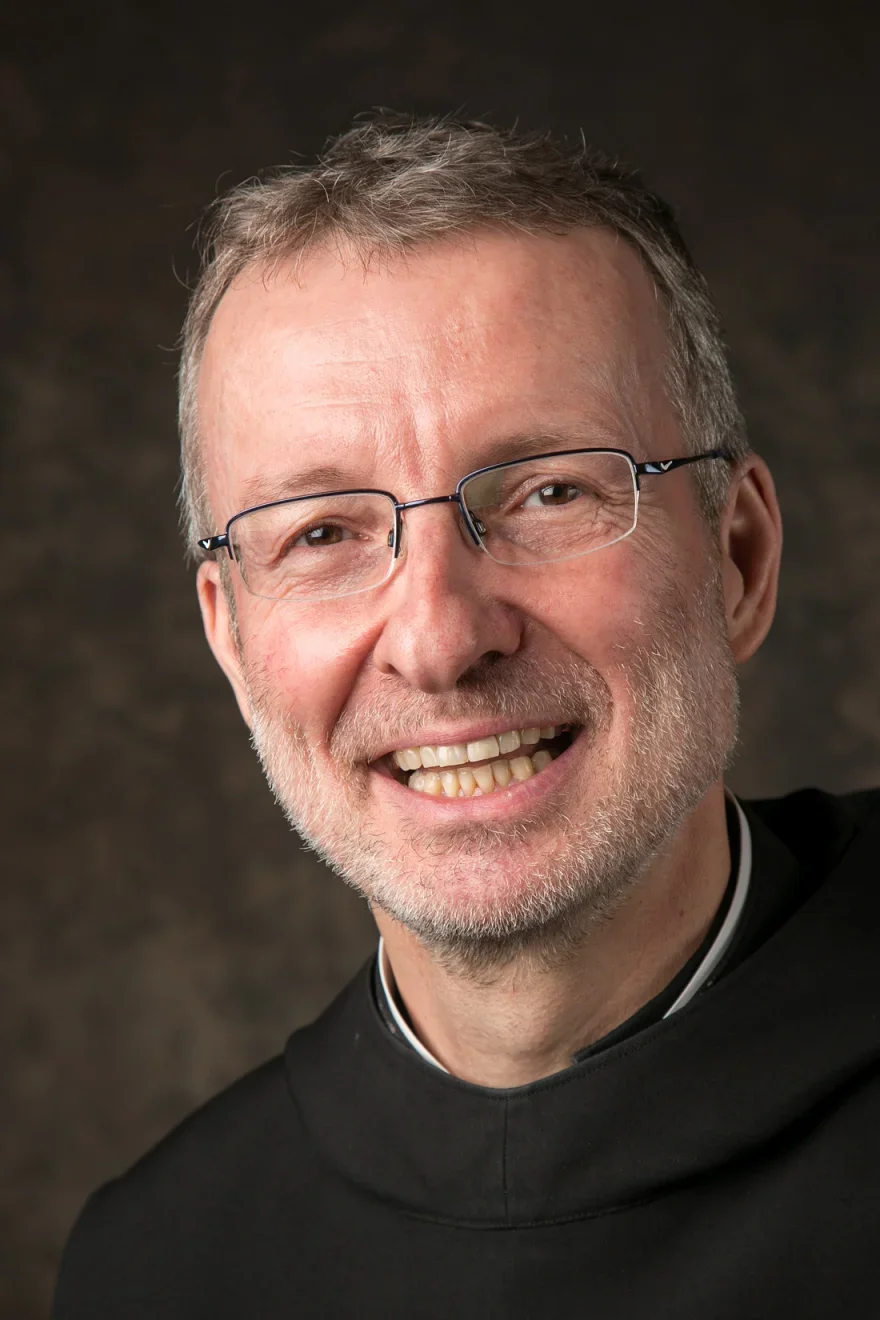
Life of Paul (detail), Aidan Hart with contributions from Andrew Jamieson, Copyright 2002, The Saint John’s Bible, Saint John’s University, Collegeville, Minnesota USA. Used by permission. All rights reserved.
St. Paul was the missionary and fruitful disciple of Jesus par excellence. In his vision on the road to Damascus, he had seen a light from heaven and encountered Christ. On the illumination in The Saint John’s Bible titled, Life of Paul, we see at St. Paul’s left elbow the arches from the entrance to the Basilica of the Holy Sepulcher in Jerusalem. Christ suffered and died for us. He was buried, but then he rose from the dead and appeared to his disciples, finally also to Saul who became Paul in the process, a new person. He considered everything as loss because of the supreme good of knowing Jesus Christ as his Lord (Philippians 3:8)
The artist depicts St. Paul wearing a Jewish prayer shawl. He had grown up as a devout Jew. This was his background, but he was open to the working of the Holy Spirit in the hearts of all people, regardless of their culture or walk of life. We see him wearing sandals. As messenger of Jesus Christ, he traveled long distances on foot. We also see part of a ship. Sometimes he traveled by boat; being shipwrecked three times was just one example of the hardships he endured on his journeys!
The broken church building that St. Paul holds in his hands resembles St. Peter’s Basilica in Rome. Christians are divided into denominations today, but St. Paul’s core message of us being justified by faith in Christ (cf. Romans 5:1-9) can bring us back into unity.
After his conversion, St. Paul first traveled to Arabia through the desert. He needed a time of prayer and of stillness (cf. Galatians 1:17). Today St. Benedict Center is a place of prayer and of stillness, too, conducive to encountering Christ and to growing in our relationship with him.
From our facility I can report that we have gotten new chillers this year which guarantee cool and dryer air in the building during the warmer months. – Especially worth noting among our upcoming events is the retreat titled, A Way to Live and Enjoy Life more Fully on December 12 – 13, 2025, with Fr. Joe Miksch from Columbus, NE. It will be about identifying and working toward eliminating inner obstacles that keep us from living the Great Commandment of Jesus. – I am looking forward to seeing you again soon!
Fr. Thomas Leitner, OSB, Administrator
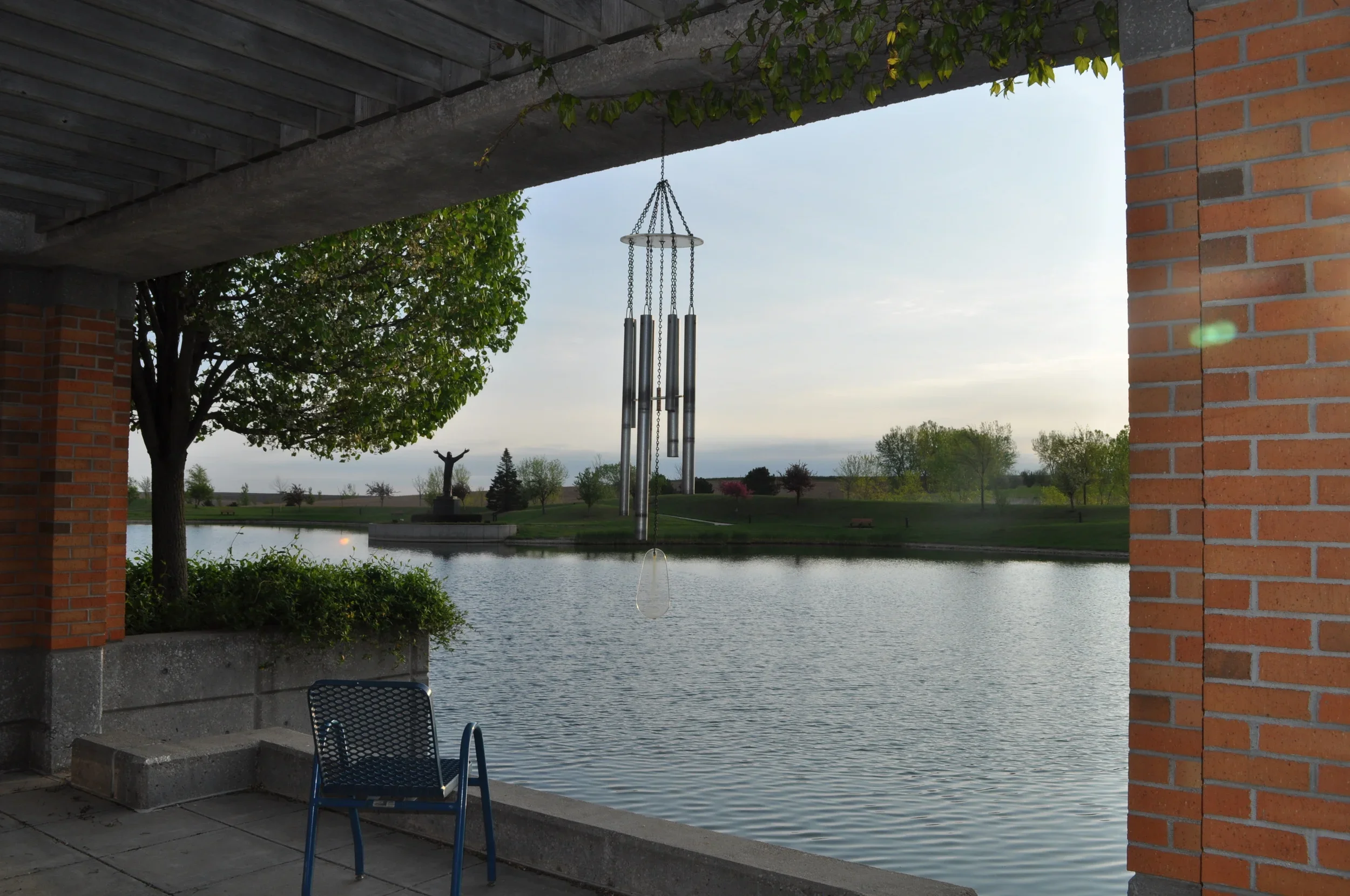
Homily, Sunday, September 7, 2025
Focus: Following Jesus means making good decisions day by day that orient us ever more clearly toward him. His promise: life in fullness.
Often we see commercials in the media with enticing announcements of something we can have for “free.” Some of us get burnt—we do what the ad asks and find out the “free” thing actually costs quite a lot. In this way a person learns quickly to read the fine print of such offers because the fine print can become the stumbling stone.
In today’s gospel, Jesus speaks very plainly with us and hides nothing. He bluntly challenges those who are with him to take up the demands of discipleship with eyes wide open. Jesus clearly spells out the fine print in large letters, so to speak: Disciples must put Jesus ahead of their families. The word ‘hate’ is hyperbolic; we understand what Jesus means when we read Matthew’s version of this verse: “Whoever loves father or mother more than me is not worthy of me” (Mt 10:37). The disciples’ families and friends (in person or virtual) must not keep us from following him, nor must possessions be in the way; nor even concern for their own lives.
This gospel passage is part of a larger section in Luke that extends over ten chapters: the narrative of Jesus’ journey to Jerusalem following his ministry in Galilee. Jerusalem is the city of Jesus’ destiny, where his suffering, death, resurrection, and ascension are going to take place. There salvation is being accomplished and from there, guided by the Holy Spirit, the proclamation of God’s saving word is to go forth. During the course of his journey to Jerusalem, Jesus is preparing those around him for the role they will play later as his missionary disciples
Great crowds are traveling with him, we hear. Jesus wants everybody to know that following him isn’t a walk in the park. His listeners are meant to “calculate the cost” of discipleship. Jesus’ message is a pretty challenging one: “If our absolute priority isn’t Jesus and his mission, then we “cannot be [his] disciple(s).” And: Following him includes carrying one’s cross.
Material things, the respect and praise of people and power and influence over others are not bad in themselves. They are God’s good gifts and they can be used for the glory of God. The problem comes in when God’s gifts become possessions. They are mine; I hold on to them.
God gives us wisdom and sends the Holy Spirit from on high, so today’s first reading tells us. The Holy Spirit shows us how to use God’s gifts aright. Today’s gospel, therefore, is an invitation to us to practice discernment: Is a thought that we entertain, a word that we speak and an action that we take the work of the Holy Spirit in us or are we allowing other spirits that aren’t the Holy Spirit to gain influence over us?
Dear sisters and brothers in the Lord, Following Jesus means making good decisions day by day that orient us ever more clearly toward him. His promise is that we will receive a hundred times more than what we have given up and, even on this earth, life in fullness.
One good way of keeping track of our everyday decision making is the Examination of Consciousness. Many people do it at the end of the day. I do it in the evening, too. I first ask God for clarity and understanding in regard of what happened in my life and in me during this past day. Then I review my day in thanksgiving. I think about the day in terms of how it was a gift. I thank God for my existence, my work, my relationships, for the food that nourishes me … and even for difficult things
that happened. I review my feelings that surface in the replay of the past day. Our feelings, positive and negative, painful and pleasing,are the liveliest index of what is going on in our lives. Then I choose one of those feelings (positive or negative) and use it as a starting point for prayer, for praise, petition, contrition or a cry for help. Finally I look toward tomorrow. I think of the tasks, meetings and appointments of the next day. Which feelings surface? I turn them into spontaneous prayer.
I conclude with the Lord’s Prayer. This method which comes from St. Ignatius of Loyola, can help us to determine when in the course of our day we fell victim to false promises and when we responded to those of Jesus.
I wish all of us and pray that as we return back into the ordinary routine of life this fall, we may do so with attentiveness toward what’s happening around us and in us and with great trust that the Holy Spirit whom Jesus has sent uswil l enlighten, guide and strengthen us on all our ways. AMEN.
~Fr. Thomas Leitner, OSB
Homily - Sunday, July 13th, 2025
Lk 10:25-37
Dtn 30:10-14
Col 1:15-20
focus: Today’s gospel invites us to respond to God’s love with ours – to God and to our neighbors, the close ones and the more remote ones as well!
The evangelist Luke relates to us some of Jesus’ most famous stories. Today we heard one of them, the Parable of the Good Samaritan. We are very familiar with it. However, this can prevent us from fully appreciating its provocative message.
Our gospel today begins with a scholar of the law (that is, a Scripture expert) approaching Jesus in order to “test” him. He asks Jesus what he must do to inherit eternal life. Jesus throws the question back at him: “What does the Bible say?” The scholar answers by combining two texts: “You shall love the Lord, your God, with your whole being” (Deuteron. 6:5) and “[You shall love] your neighbor as yourself.” (Leviticus 19:9). Jesus wholeheartedly approves of this answer.
In fact, the heart of Jesus’ own teaching is expressed in these words. God has loved us into being and showers us with gifts. Our first love, in return belongs to God: with heart, mind, strength and our entire being. Second, love of God is closely connected with love for all God loves: all human beings
and all creation. In fact: Love for God is expressed through love of one’s neighbor as especially Luke’s Gospel makes clear.
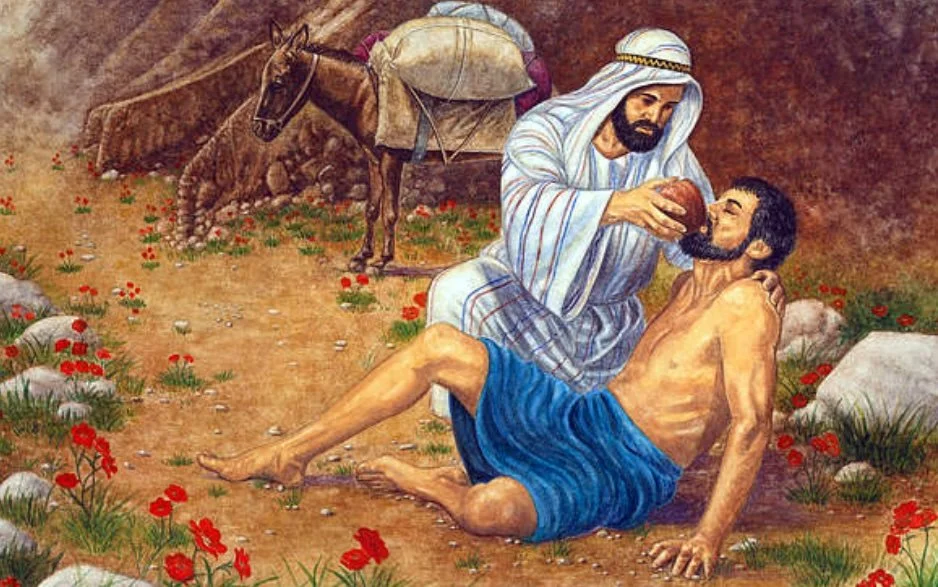
“And who is my neighbor,” the Scribe asks. Jesus, in response, tells the Parable, challenging the scholar, and us, not to limit too narrowly our notion of “neighbor!” The road from Jerusalem to Jericho, as Jesus’ listeners knew, was very dangerous. It was filled with bandits. Using it was unsafe, especially for one who traveled alone. It was one such traveler whom Jesus describes as being beaten, robbed and left for dead.
The first two people who come across the dying man are religious professionals, a priest and a levite (an altar server of sorts). However, they, concerned about their own safety and about maintaining ritual purity, don’t take action to help the dying man. Jesus’ listeners must have been surprised at the inaction of the priest and the levite!
What follows in the story is even more shocking. There was a centuries old antipathy between Jews and Samaritans. In response to a supposedly pious Jew’s question Jesus makes a Samaritan, not an Israelite, the hero of the story! The Samaritan reacts with compassion upon seeing the beaten man,
binding his wounds and seeing to his care and recovery. The story illustrates dramatically how love for God is empty if it is not expressed in real concern for others. Jesus describes how true love is to be expressed and how we are to regard those most in need, even strangers, as our neighbors. Plus, he shatters his listeners’ prejudices that limited their ability to see goodness in people different from them.
Today’s first reading from the Book of Deuteronomy underlines this point by saying what is really important to God is not too mysterious, not difficult to understand. What is necessary for us is to know God’s commandment, having it on our minds and in our hearts and to carry it out, to put it into practice!
In today’s second reading St. Paul points us to Jesus in whom the fullness of God “was pleased to dwell.” He combined perfectly and to the full in himself the two dimensions of love for God and love for neighbor. He lived in union with God. And he himself as it were became the Good Samaritan, making God’s care for all, especially for those most in need, visible even to the end, when he shed his blood on the cross.
Sisters and brothers, Today’s gospel invites us to respond to God’s love with ours – with love to God and to our neighbors, the close ones and the more remote ones as well! Loving God first means making regular contact with God in prayer a priority: Personal prayer, reading Holy Scripture prayerfully, attending communal worship, Adoration. God loves us the way we are, we can bring to God in prayer everything that is going on in our life. God’s compassion can reach us even where we are wounded – like the Samaritan’s love reached the man on the road!
On the other hand, our love and concern for other people must grow in its quality and in its reach, toward wherever we find someone who resembles the victimized traveler in the story.
We also must think globally. The U.S. Administration has issued a rescissions package to cancel funds Congress already approved for programs that respond to major emergencies around the world and that help children, families and communities. Countless human lives are at risk. Adjustments are still being made in the US senate till July 18, and we can express to our senators that this is important to us! We are called to such action, too, because, as Pope Francis expressed it in the title of his last encyclical, we, people everywhere around the world, are Fratelli Tutti, Brothers and Sisters All.
AMEN.
~Fr. Thomas Leitner, OSB