
Homily: A Life Given Away
I saw a quote the other day that is often attributed to Pablo Picasso and it reminded me of today’s readings:
“The meaning of life is to find your gift. The purpose of life is to give it away.”
All of us have been given something. We have gifts, talents, experiences, opportunities. God has placed something in each of us that is meant not simply for ourselves, but for others.
Jeremiah discovered that.
God had called him to be a prophet, and there were days when Jeremiah wished God had chosen somebody else. His calling brought him criticism, rejection, and suffering.
Jeremiah had had enough, so he said, "I'm done, I won't talk about God anymore."
The problem for Jeremiah is he can’t stop. Its like a fish trying to stop being a fish, or a bird to stop being a bird. They can’t.
Jeremiah feels like the Word of God is burning inside him, it's like a fire that's growing stronger every minute. It's deep in his heart and it's spreading to his bones; he can't keep it locked up, it's bursting to get out.
Jeremiah had discovered his gift, and he realized that he had to give it away.
This is what today’s Gospel is all about.
Jesus tells his disciples that he is going to Jerusalem, where suffering and the cross are waiting for him. Peter objects. He wants to protect Jesus.
Jesus knows something that hasn’t yet clicked with Peter.
A life spent protecting itself at all costs eventually becomes a very small life.
Jesus says:
“Whoever wishes to save his life will lose it, but whoever loses his life for my sake will find it.”
Jesus isn't saying that life has to be unhappy. What he's saying is that the best part of life is when we stop thinking just about what we can get, and start thinking about what we can give. When we focus on giving, that's when we find the most joy. He wants us to know that it's not all about what's in it for us, but about how we can make a difference in the world. And that's where real happiness comes from. This is what it means to be a follower of Christ.
Most of the time, giving our lives away happens in very ordinary ways.
A parent gives time and love to a child.
A teacher gives knowledge and patience to students.
A friend sits and listens.
We make someone laugh.
We volunteer for an afternoon.
Someone visits a person who is lonely.
A monk or sister gives themselves through prayer, community, hospitality, and service.
We give away our time, our compassion, our forgiveness, our talents, and our love.
Something wonderful happens.
The more we give ourselves away in love, the more we discover who we really are.
This is one of the great paradoxes of the Gospel.
We find our lives by giving them away.
That is exactly what Jesus does.
Jesus shares everything that God has given to him. He gives us his words, his kindness, his forgiveness, his love, and his body and blood. In the end, he even gives us his life.
The cross, which looks like the loss of everything, becomes the doorway to resurrection.
This is what makes today's Gospel so incredibly uplifting, not gloomy or sad.
Jesus is telling us where life can be found.
God has given each of us a gift. Maybe you know exactly what yours is. Maybe you are still discovering it.
But whatever God has placed within you, don't keep it to yourself.
Give it away. In doing so you sometimes will find great joy, but more often than not you will find contentment and peace!
The Christian life is not about gloom and doom. It’s not about rules and trying to control the world and everyone who lives in it.
The Christian life is to be lived as HE lived.
In a few moments we will continue our celebration with the breaking of bread. Jesus says to us:
“This is my Body, given for you.” "This is my blood, poured out for you."
We receive Christ, who gives himself completely to us, and then we go out and give ourselves to each other.
“The meaning of life is to find your gift. The purpose of life is to give it away.”
“Whoever loses his life for my sake will find it.”
When we give our lives away in love, that is when we truly find them.
- Fr. Adam Patras, OSB
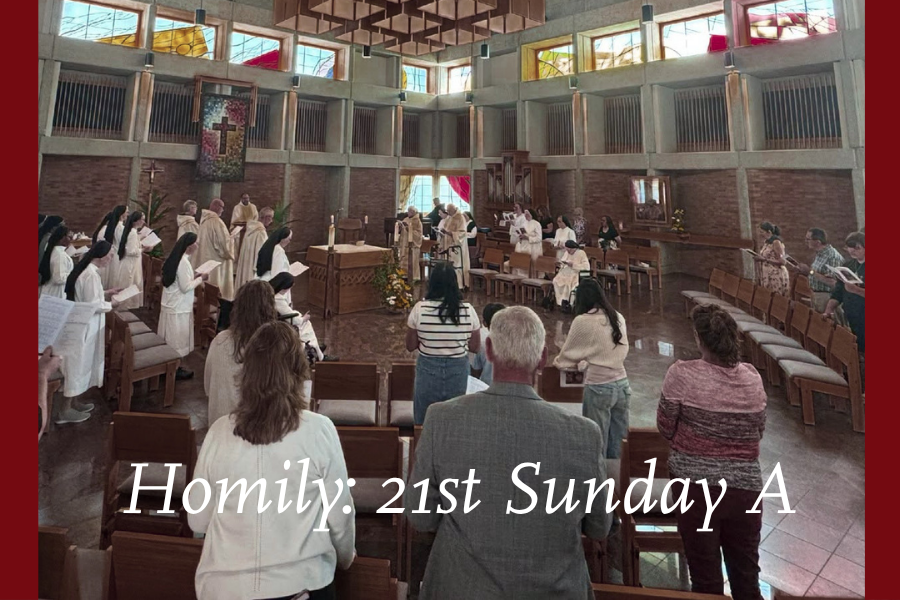
Homily 21st Sunday A
Homily 21st Sunday A 2026 Mt 16:13-20 Is 22, 15.19-23 Rom 11:33-36
The place which was called Banias or Caesarea Philippi at Biblical times
and which can be visited even today in Israel, impressed me very much
during my pilgrimage to the Holy Land years ago
because of its extraordinary natural beauty. The springs of the Jordan River are there,
water gushes forth from the rocks and from the ground
and collects in a round natural basin of crystal-clear water.
Rocks form a natural amphitheater. For many centuries before Jesus,
this had been a place of prayer. There were temples of Greek gods.
People simply felt that this was a holy place
where it was easier to get in touch with God.
There Jesus invites his disciples in today’s gospel
to reflect about what they have seen and heard in his company so far,
about the people’s comments on him and his person,
and about their own thoughts in regard of him.
Peter acknowledges Jesus as “the Christ, the Son of the living God.”
Peter receives this insight as a gift, as revelation.
In our Sunday gospel two weeks ago, Peter expresses who Jesus is (“the Son of God”),
when he is saved from the stormy waters, despite his doubt.
Jesus reveals who he is through Peter’s experience of freight, sinking and being saved.
Peter pays attention to the experience.
This is the basis upon which his confession in today’s gospel is made.
The other disciples, without such a captivating personal experience
of Jesus’ saving power, answer Jesus’ question about who he is
according to traditional Jewish expectation. Peter, on the other hand,
has had a new experience of God’s saving power in Jesus
and thus answers from a deeper stance of faith than the others,
from a knowledge that the ‘heavenly Father’ has revealed to him.
Peter confesses Jesus as the long-awaited Messiah.
Jesus then announces that he will build his church on Peter, the rock.
Both the experience of fear and grace and the divine inspiration
lead to the confession of who Jesus is.
That Jesus, the Son of Man, is the Son of the living God, the Christ,
the long-awaited Messiah, is a truth that must be revealed.
Our faith as Christians today comes from hearing:
What was revealed to Peter is God’s Word, God’s revelation, also to us:
Jesus is the Christ. This revelation, if we really hear it and believe it,
becomes the rock-solid foundation for our lives.
My sisters and brothers, knowledge of God is not something that we can make happen;
it is God's gift and grace. What matters for us is to be attentive
to the different ways in which God communicates himself to us.
One source of God's revelation to us is Holy Scripture,
especially the New Testament, which presents to us today Jesus
as the Lord of our lives upon whom we can rely on.
The fullness of God's self-communication is given to us in Jesus Christ,
but we need continuous guidance of the Holy Spirit
who helps us to understand God’s revelation ever more fully.
We need the Church, which Jesus built on the foundation of Peter
and his successors. I feel very much supported, encouraged and challenged
by the teaching of Pope Leo that I hear every night on Vatican news.
One quote may suffice. “Be agents of communion,” he recently said,
“capable of breaking down the logic of division and polarization,
of individualism and egocentrism. Center yourselves on Christ,
so as to overcome the logic of the world, of fake news, of frivolity,
with the beauty and light of truth.”
Besides Scripture and Church teaching, our own lives, our experiences
of danger and rescue, our daily encounters with people
are a source of God's revelation to us.
As it was for Jesus and his disciples at Caesarea Philippi,
so it is good also for us on occasion to take time for praying more intensely,
for becoming quiet, for reflecting on the ups and downs of our life,
in order to see more clearly the working of God.
Our retreatants are doing just that here at this place.
God's riches and wisdom are unfathomable and inexhaustible.
Let us thank God and give glory to God for the ways in which
God has already sheared with us from this treasure. AMEN.
Fr Thomas Leitner, OSB

Homily 19th Sunday A
Homily 19th Sunday O.T. A SBC Schuyler 2026 Mt 14:22-33 1 Kg 19:9.11-13 Rom 9:1-5
An unbelieving scientist was on an expedition through the desert, guided by some Arabs.
At sundown the Arabs spread out their carpets and prayed. “What are you doing,”
the scientist asked one. “I am praying.” – “To whom?” – “To Allah.”
“Have you ever seen, touched, or felt Allah, your God?” – “No.” – “Then you are foolish.”
The next morning, the scholar, crawling out of his tent, said to the Arab:
“A camel was here tonight.” Now the eyes of the Muslim lit up:
“Have you seen, touched, or felt it?” – “No.” – “Then you are a strange scholar.”
“Well, we see its footprints all around the tent!”
At that very moment the sun rose in all its splendor.
The Arab pointed toward it and said: “There you see the footprints of God!!” –
God’s presence is all around us. We only need eyes to see.
Today’s gospel comes in two parts. First, it presents us with Jesus
spending a night on a mountain in prayer. Before the Feeding of the Five Thousand,
last Sunday’s gospel, which precedes our text today, Jesus had heard
about the execution of John the Baptist, his cousin.
Apparently, he needed time to deal with this sad news.
John, as well as Jesus, had proclaimed the message:
“Reform your lives! The kingdom of God is at hand!” Jesus respected John highly;
and Jesus knew that he, with his words and deeds, was in danger, too.
For Jesus, the night on the mountain probably was, humanly speaking, a time of grieving
and of handing himself over anew completely in prayer to God, his heavenly Father.
Second, there are the disciples who cross the Sea of Galilee at night.
They are scared when their boat is tossed about by the waves.
Even when Jesus himself is with them they first don’t recognize him;
rather their fear increases. Then there is this special scene with Peter,
who, realizing that it is Jesus, wants to approach him immediately, leaving the boat.
As long as his eyes are fixed on Christ, he can master the waves.
But when he looks at the storm and at the waters, he becomes fearful and is about to drown.
Sinking Peter then directs his attention back to Jesus, exclaiming: “Lord, save me!”
Peter is rescued and the wind dies down.
Both parts of this gospel are images for our own lives. When we are confronted
with challenges, it can happen that God gets out of sight for us.
As it was with the disciples who didn’t recognize Jesus, so we sometimes
don’t take the signs of God’s presence for real. God is the “I AM,”
the one who is with us always, loving us and caring for us.
For us, too, it is appropriate, when we are in trouble, to call out:
“Lord, help me, rescue me!”
But also Jesus’ night of prayer has a lesson for us: We, too, need regular times
of being with God, of letting ourselves be enveloped by God’ presence, as Jesus did.
My sisters and brothers, in Jesus praying on the mountain, in the disciples in the boat,
and in sinking Peter we can see images of us and of our church.
What we need is attentiveness to God’s presence and trust in the One who can support us
even and especially in the stormy periods of our lives and of our world.
It is good to build times into our day, our week and our year when we hand over
our lives and everything that is going on completely in prayer to God,
or when we simply become silent in God’s presence like Jesus on the mountain
or like Elijah in his cave.
During the activities of our day, we can continue our prayer,
for instance, with the well-known Jesus Prayer of the Eastern Church,
“Lord Jesus Christ, Son of God, have mercy on me.” We can repeat this line
throughout the day, whenever our mind is free to do so.
Such continuous prayer has a transforming effect on our lives.
The scientist in our story didn’t pay attention to the presence, the ‘footprints,”
of God’s mystery in the wonderful sunrise. If we continue to pray
and to be attentive to God, the “I AM,” with us and within us,
then we have no reason to fear and to worry too much in whatever situation we are.
May the Eucharist we share transform us and empower us
to be, in our daily lives and in an often very secular and stormy world,
signs and instruments of God’s presence and work. AMEN.
~ Fr. Thomas, OSB
Homily: The Greatest Treasure
Most of us are familiar with the Antiques Roadshow! If you are not, google it later. People bring their old stuff from home to be evaluated by experts, sometimes to them its treasure, sometimes they just hope it might be worth something. Some go away disappointed, and some are told that this bit of junk is worth a lot of money.
You never know what's going to turn up as a treasure. It could be something like an old coin that's been lying around, a baseball card that nobody thought was special, or some antique that's been collecting dust on a shelf. One minute it's just something taking up space, and the next minute someone tells you that it's really valuable, way more than you ever thought possible.
My parents owned an antique shop, and they often took great delight in finding something that was valuable or unique that others thought was junk or worthless. They would become like little kids, full of excitement, wonder, and joy. Sometimes they would use their last bit of money to purchase the precious items.
That excitement, that exact feeling Jesus wants to give us in today’s two short parables.
A man discovers a treasure buried in a field. Another man finds the finest pearl he has ever seen. Both immediately sell everything they own.
According to Matthew, the first man left feeling completely overjoyed. His thoughts weren't filled with worries like "I have to get rid of all my stuff." Instead, he was thrilled, thinking "This is amazing, I've stumbled upon something incredible!"
That's the difference.
When you stumble upon something that's precious, you don't waste your time thinking about the price tag. Instead, you just feel thankful that you've discovered it. It's like finding a treasure - you're so happy to have it that you don't care what it cost, you're just grateful it's yours.
I felt this way when I had found the monastery here, and Fr. Anastasius too shared the joy he felt on his first night in the monastery! Neither of us thought about what sacrifices we might have to make, but what a wonderful thing we had found.
I think sometimes we Christians accidentally give the impression that following Jesus is mostly about giving things up. We talk about sacrifice, rules, obligations, and crosses to carry. Those things are certainly part of discipleship.
But before any of that comes joy.
The early followers of Jesus were drawn to him because he brought a profound transformation in hearts and in their lives. They experienced forgiveness, which gave them a new lease on life. They found hope, a sense of purpose that guided them through life's challenges. And they discovered a love that was more powerful than any obstacle, even death. This love was Jesus, and once they encountered him, nothing else seemed to matter. He was the one who changed everything, and they were forever changed by knowing him.
What do I treasure most?
What we treasure has a big impact on how we live our lives.
If following Jesus is just one more burden I have, more set of laws and rules I must follow, then faith will eventually feel like a burden.
But if Jesus is really one of the most valuable things we can have, then following him isn't just something we have to do, it's something we want to do because it ultimately brings us joy.
As we gather for the Eucharist today, it's not just about checking off a weekly duty. We're here to receive a gift that's beyond anything we could ever imagine. Each time we gather at the altar, God generously places this incredible treasure right into our hands, reminding us of His love and presence in our lives.
May we never lose the joy of having found him.
~ Fr. Adam Patras, OSB
Homily: The First Word of the Rule
The first word of the Rule is one of the most important words St. Benedict ever wrote: Listen.
Not work.
Not pray.
Not obey.
Not serve.
Listen.
That is exactly where today's readings begin. Proverbs tells us to receive God's words, to incline our ear, to seek wisdom as though searching for hidden treasure. Paul reminds us to let the word of Christ fill our lives completely.
The apostles, were not so great listeners… otherwise they would not have been arguing about who was the greatest among them just hours before Jesus was to suffer.
Jesus Himself, on the other hand, listens perfectly to the Father, and because He listens, He knows that His place at the table is not one of privilege but of service.
Listening should always lead to service.
I sometimes wonder if one of the greatest temptations in Benedictine life is that we stop listening because we think we already know.
We know the Rule.
We know the schedule.
We know the psalms.
We know how Chapter goes.
We know the customs.
We think we understand our vows.
We're familiar with each other's strong points, but it's probably even easier for us to see where we each struggle. Our weak points.
Without realizing it, we can begin living on yesterday's listening. But St. Benedict didn't want the monastery to just be a place where old traditions were kept alive.
He wanted it to be a place where people could learn and grow in their faith, a place where every day we're still learning to listen to Christ's voice, to serve others, to really love, and to follow his example.
It's a school of the Lord's service, where we're constantly learning and trying to become better servants of God, become more and more the hands and feet of Christ.
The foundation of the Rule is rooted in scripture and listening, and from this core principle of LISTENING, all other Benedictine values naturally emerge and unfold.
If I stop listening to Christ, I will stop listening to my brother or sister.
If I stop listening to my brother or sister, patience becomes difficult.
Forgiveness becomes difficult.
Hospitality becomes difficult.
Mission becomes difficult.
Service becomes difficult.
Eventually, service becomes little more than duty. When we really let the words of Christ sink in, and transform us, something amazing happens. We start to feel more compassionate, kind, humble, gentle, patient, and loving.
It's not just about trying hard to be these things, but about letting God's grace work in us.
Perhaps that is why Jesus says, "I am among you as one who serves." His service is not a strategy. It is the natural expression of His perfect communion with the Father.
The same is true for us. Our work as missionaries, the way we welcome others, our life together, our prayers, the things we do to help others, and even our everyday tasks will only be truly effective if we start by listening.
The world needs many things from Benedictines. The world needs, our schools, retreat houses, missions, our hospitals, and ministries. It needs our example of community, of loving service.
However, before anything else can happen, it's essential that we, as individuals, learn to listen deeply to God. The world needs people who are willing to truly hear and understand His message.
That's always been the thing that comes first.
As we come together around the altar, we're reminded of our role as listeners. But before we can go out and serve others, we need to let Christ serve us first.
He shares His message with us, and He gives us His body and blood to nourish us.
As we receive from Him, He sends us out into our daily lives, whether that's in a monastery, on a mission, at work, or at home.
It is not just to get things done, but to listen more deeply to those around us. When we really listen to Christ, we start to serve others in the same way He served us.
It's a beautiful cycle of listening and serving, and it's one that can transform our lives and the lives of those we touch. By listening to Christ, we're able to tap into His heart of service, and we're empowered to make a real difference in the world.
May our Holy Father Benedict, his Holy Sister Scholastica, pray for us that we may be good listeners in the school of the Lord’s service, and may our listening help us to bring Christ to those we daily encounter.
~ Fr. Adam Patras, OSB
Homily: 14th Sunday A
Homily 14th Sunday: O.T. A SBC 2026 Mt 11:25-30 Zec 9:9-10 Rom 8:9.11-13
focus: We may hand over our burdens our troubles and burdens to Jesus and rest with him.
function: This strengthens us for living according to His teaching and example.
“I will give you rest from all your enemies,” God says to King David in the Old Testament. The promise is being fulfilled. David gains victory over the neighboring peoples and establishes his kingdom.
He can rest mainly because of his military strength.
The Kingdom of God that Jesus proclaims is quite different!
The early Church saw Jesus’ way of being king symbolized by his entry into Jerusalem riding on an ass, not on a horse
like the Romans, the ruling power at the time, would do after a victory, leading prisoners behind them from the defeated army.
An ass wasn’t an animal to ride on in combat.
Jesus didn’t present himself at all as the leader of an army, nor even of a guerilla group.
Rather Jesus had experienced inner strength and radiated it to a degree that he had no need for weapons and armor.
People could feel secure with him and find rest with him because of his inner freedom that nobody and nothing could take away from him.
Jesus must have instilled in his listeners and followers a longing for this inner strength and freedom when he said,
“Come to me all you who labor and are burdened and I will give you rest.”
Who were the people who actually did come to Jesus?
Mainly ordinary folks, the largely uneducated and simple population of Galilee.
They flocked in great number to access his healing power.
Their overall positive response implies revelation from God, since, lacking expertise in such matters, they had no other means of knowing and understanding.
The Pharisaic teachers, on the other hand, through the way they interpreted the Torah, the law of Moses, according to their tradition, imposed heavy burdens upon others.
Their many rules, their 613 commandments and prohibitions, couldn’t be kept by many ordinary people because of the way they had to earn their living.
We only have to think of shepherds and ass drivers. They largely lived outdoors and found it hard to keep all the required purity laws.
Jesus in turn proposes his ‘yoke’ to them that is easy, his burden that is light.
He is happy about all who receive and accept his message:
“I give praise to you, Father.” You, the Lord of heaven and earth, have revealed the message of your kingdom to little ones, to simple hearts.
Those, however, who put all their trust in outward things, in possessions, those who are caught up in a good life, those who think they have all the answers, for them it is harder to gain access to God, to the mystery within us and in all reality.
My sisters and brothers, we, too, can learn from Jesus; and we may hand over our troubles and burdens to Jesus and rest with him. This strengthens us for living according to his teaching and example.
Pope Francis expounded the subject matter of resting with Jesus in his encyclical titled, in Latin, Dilexit Nos, in English, He Has Loved Us.
In Jesus, God’s love became visible and tangible in an unsurpassable way, Pope Francis says. He quotes St. Augustine who commented that John, the Beloved Disciple, while reclining on Jesus’ bosom during the Last Supper drew near the secret place of wisdom. There he received strength from Jesus and there he learned from Him, grew in that wisdom which the heavenly father reveals to the humble.
The same will happen to us if we spend time in silent prayer and adoration with the one who invites us with all of our burdens to stay and to rest with him.
This communion with the Lord empowers us, so the late pope, to become joy-filled missionary disciples who bring about a joyful encounter with the love of Christ and who find Christ in every other person.
Jesuit Fr. Greg Boyle is someone who embodies in our time the freedom and the inner strength that come from Jesus.
He the founded Homeboy Industries, which rehabilitates ex-gang members and convicts in Los Angeles.
“There (in prison) we were watched,” one of them said. “Here we are seen, respected.”
Let me close with a personal maxim of Fr. Greg, which we have to hear from the background of his challenging work:
“Today I will surrender into the arms of the God of love and then choose to be these arms.” (2x)
That’s what the gospel invites us to today.
AMEN.
~ Fr. Thomas, OSB
Easter Homily
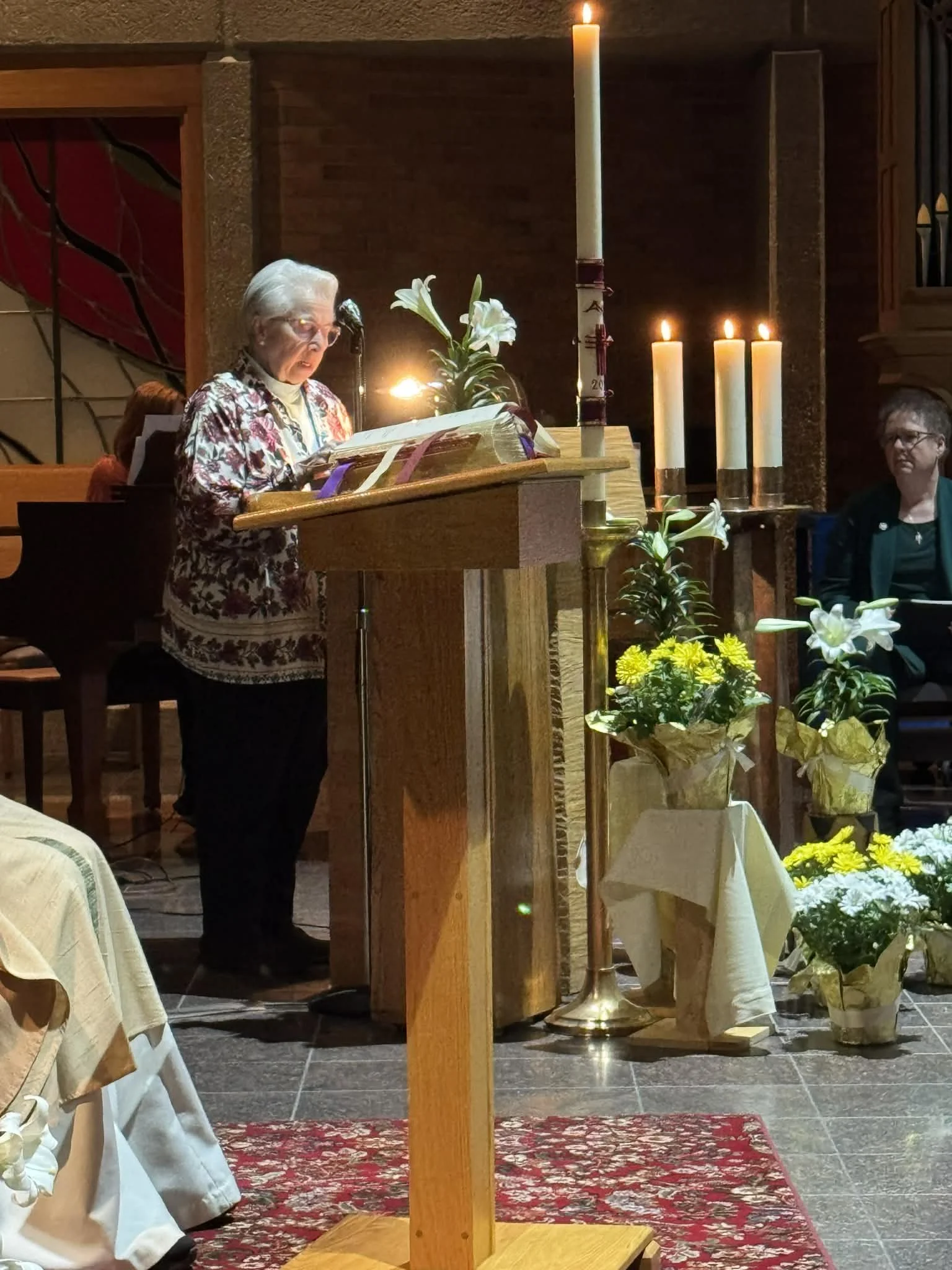
So here we are, early in the morning, at the tomb. The stone is still there, the grief is still there, and it seems like the story is over.
Mary Magdalene and the other Mary aren’t going to the tomb expecting a miracle. They’re carrying loss, confusion, and the kind of heaviness we all know.
Then everything changes.
The earth shakes, the stone is rolled away, and suddenly what looked final, isn’t.
There is something here we really shouldn’t miss, the first people to witness this, the first ones entrusted with the news that Jesus is risen, are women.
In their time, their voices didn’t carry much weight. And yet God chooses them first. - That tells us something important. This tells us God doesn’t work the way the world works. God sees differently, chooses differently.
This is still true TODAY. This still matters today. We’re still figuring out how to listen to the right voices, how to honor people’s dignity, how to not overlook those on the margins.
The resurrection begins with people who simply show up in love.
The angel says, “Don’t be afraid… He’s not here. He’s been raised.”
The Marys are invited to see, and then they’re sent: go and tell.
So, they run off with what I can imagine was a mix of fear and joy. That feels right, doesn’t it? There’s a lot in our world that brings fear, uncertainty, division.
But there’s also real joy, because God is still at work, because death doesn’t get the last word.
But as the ladies are headed to fulfill the task they have been given, Jesus meets them.
Right in the middle of it all. Not when they’ve figured everything out, but while they’re still processing the whole thing, still running.
Jesus says: “Do not be afraid.”
We too need need to hear that. A lot. Just as the Angels spoke to the Shepherds, just as the Angel Gabriel spoke to Mary, just as God Spoke to Joseph in the Dream, and just as Jesus spoke to the disciples ; Don’t be afraid!
The risen Jesus sends the ladies on their way to TELL the others.
That’s how the Gospel moves forward, someone carries the message. And it starts with the women the world might have overlooked. The women who were just out to do the loving task of visiting the tomb of their beloved teacher and friend.
Today, on this Easter Morning God is asking us to carry the message out into the world.
But God is asking us to see differently. To listen better. We are asked: Who do we over look???
We are asked to recognize hope where we thought there wasn’t any. We are asked to discern the spirits. What voices give life to the world? What things and people give life? What things or people spread discord and violence and hatred? These last ones are not from God, are not part of the GOOD NEWS!
There are still plenty of tombs in our world, things that feel sealed, stuck, beyond fixing. Tombs of hatred, discord, and violence and war. Discrimination of minorities, people of color, the stranger, and of women.
But Easter says God isn’t finished.
Christ is risen. Hope is real. And it’s meant to be shared with all people… he died and arose ONCE…. And FOR ALL!
On this Easter Morning, as we celebrate this act of love, trust that Jesus will meet you along the way, in the in the Word, in the Eucharist and then go and tell the world by your words, but mostly by your lives, the Good News! And above all “do not be afraid”.
Jesus has been raised! Alleluia!
~ Fr. Adam Patras, OSB
Holy Saturday
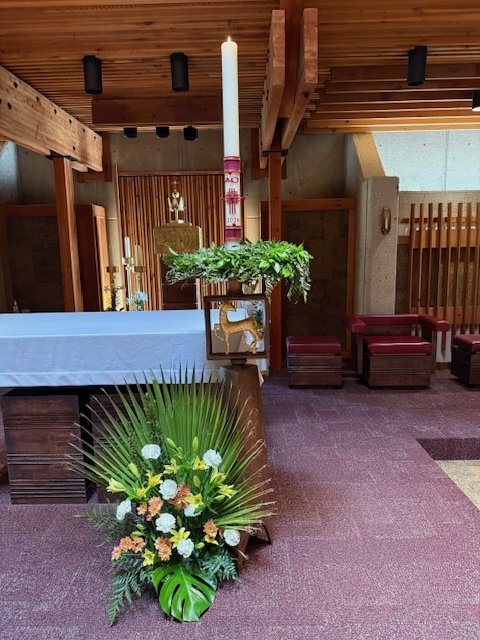
Then comes Holy Saturday, a day unlike any other. The Church is quiet. The altar is bare. Christ lies in the tomb.
This isn’t simply a day of waiting or preparation, but a day to sit with the reality of death, with absence, with grief. It’s a day when we are invited to stand in solidarity with all who know loss: those who mourn loved ones, those who live in the midst of war and violence, those who carry silent suffering in their hearts. On this day, we don’t rush ahead, we remain in the stillness, trusting that even here, CHRIST is at work in ways we cannot yet see.
~ Fr. Adam Patras, OSB
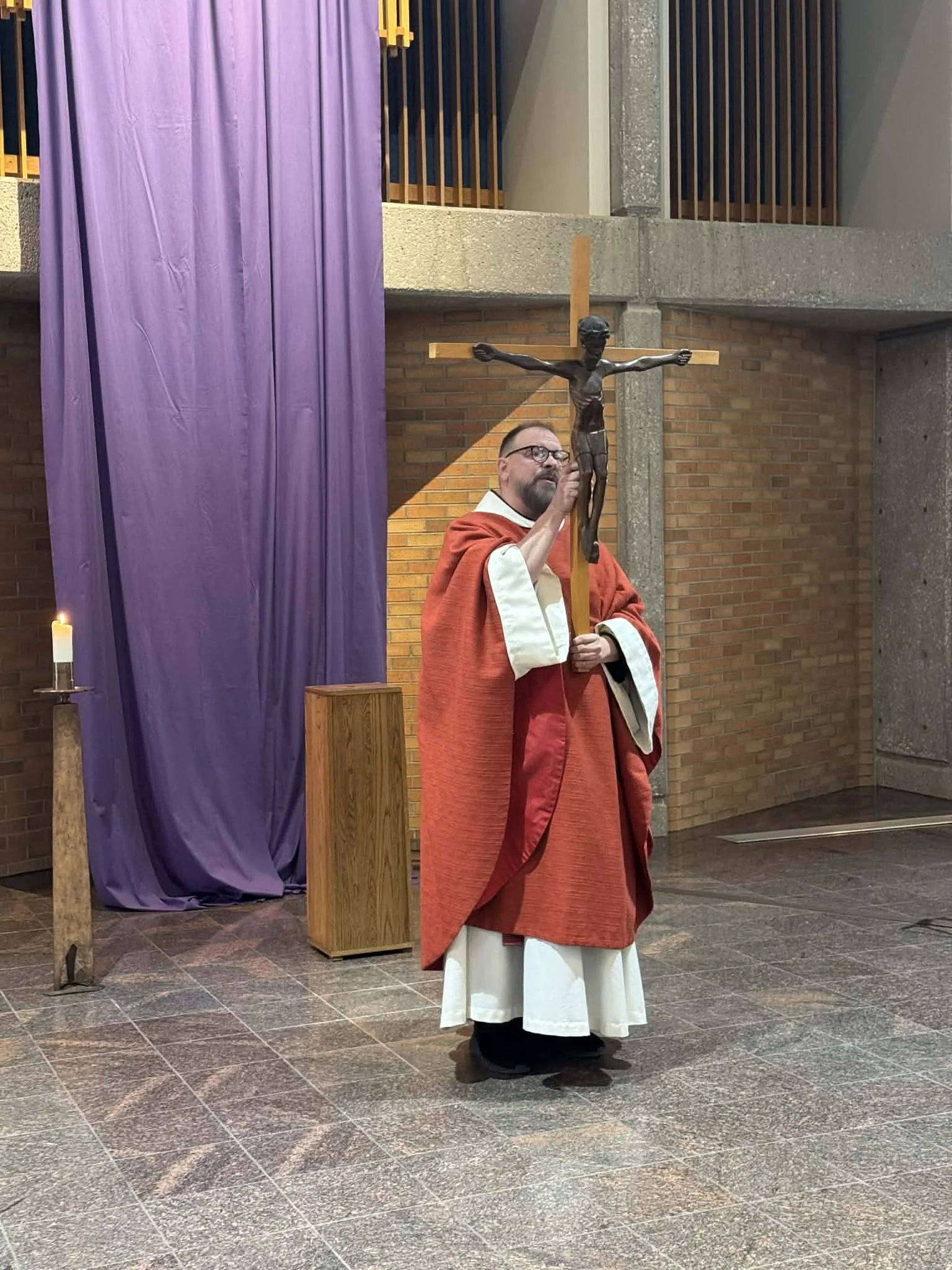
Good Friday
On Good Friday, we come face to face with the cross. We will venerate the wood of the cross, not as a symbol of defeat, but as the place where sin and death are conquered. In that solemn moment, we remember that Christ freely embraced suffering for our sake, and we bring to that cross all the suffering of our world, trusting that none of it is beyond His redeeming love.
~ Fr. Adam Patras, OSB
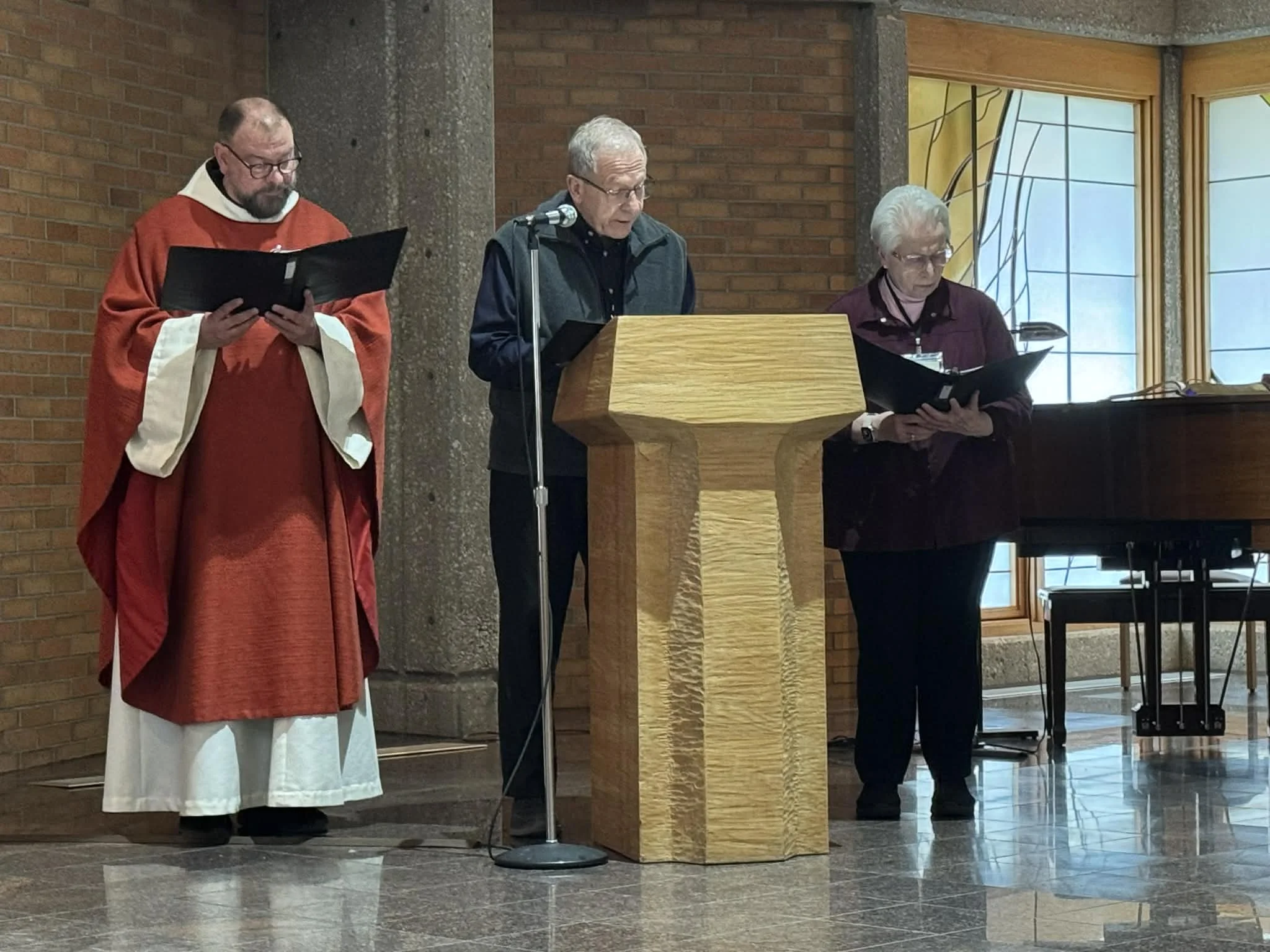
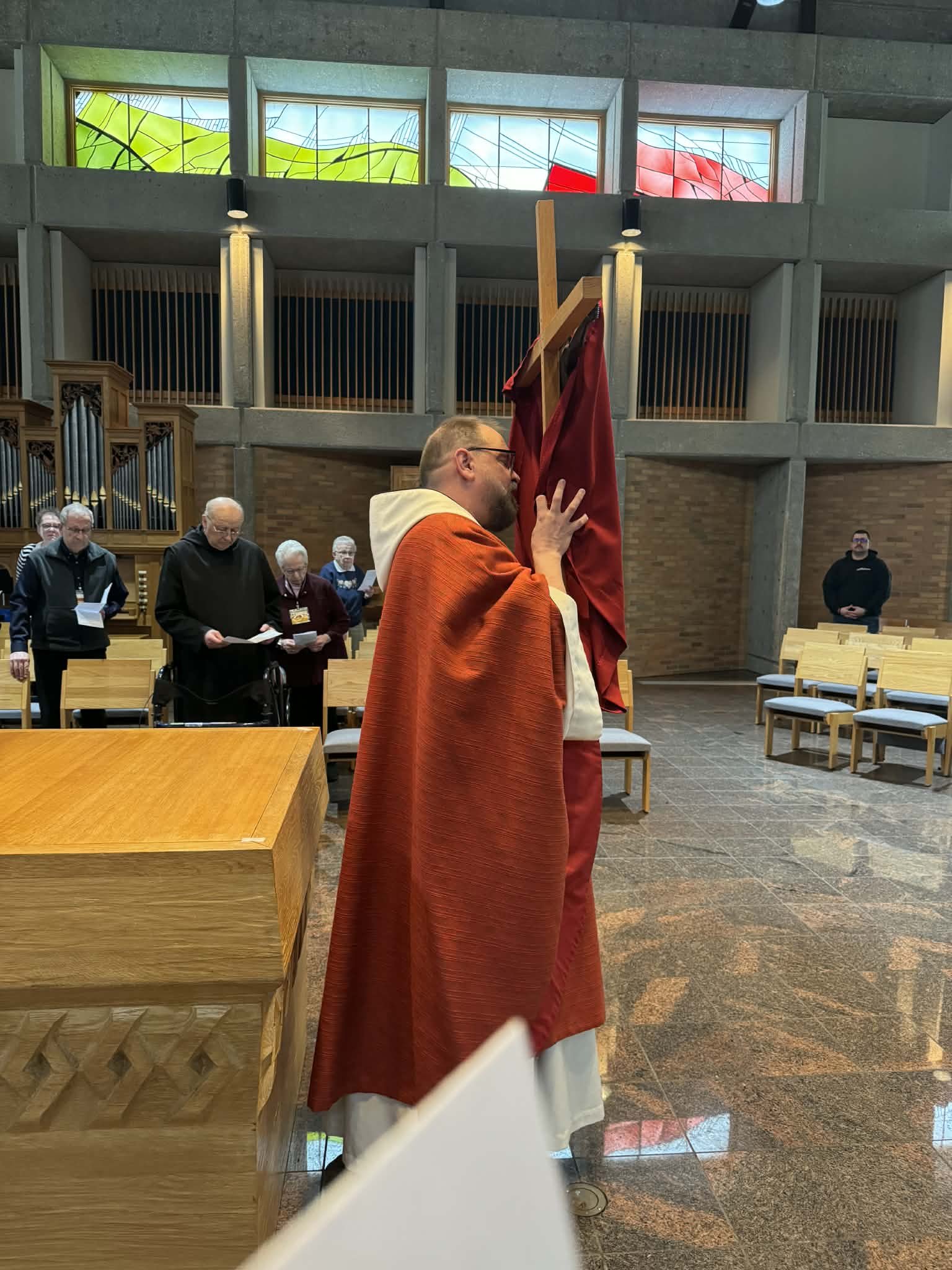
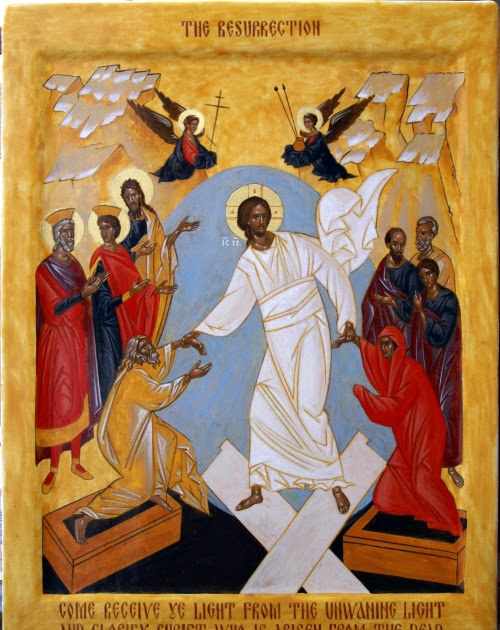
Join us for The Easter Triduum at Christ the King Priory (St. Benedict Center)
You are invited…
…to celebrate with the monastic community and retreat participants
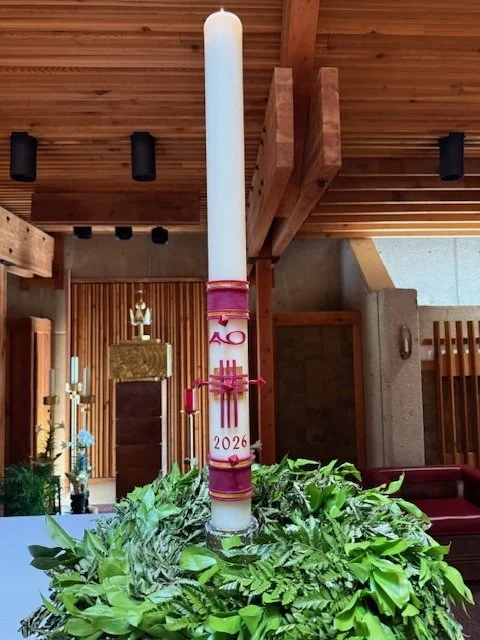
The Easter Triduum 2026
at Christ the King Priory – St. Benedict Center, Schuyler, NE
April 2, 7:00 PM
HOLY THURSDAY
Mass of the Lord’s Supper
April 3, 3:00 PM
GOOD FRIDAY
The Celebration of the Passion of the Lord
April 4, 5:30 PM
Holy Saturday
Evening Prayer for Holy Saturday
No Eucharist today
April 5, 5:00 AM
Easter Vigil
Easter Sunday of the Lord’s Resurrection
Please note: There will be no Mass at 9:00 AM
All celebrations will be at St. Benedict Center, 1126 Road I, Schuyler, NE 68661.
1st Sunday Of Lent Homily: Jesus Stands for Us!
In the first reading from Genesis, we see humanity at the very beginning. God forms Adam from the dust of the earth and breathes into him the breath of life. It’s a beautiful image! We are not accidents. We’re not random. We’re personally shaped and personally loved. God breathes His own life into us.
God sets humanity into the garden of paradise. “You may eat of every tree…except for the one in the middle of the garden”. Our story with God begins in generosity.
But the serpent introduces a question: “Did God really say…?” The real temptation is the suggestion that God is holding something back. That God cannot be trusted. That we must take matters into our own hands to be fulfilled.
And that is where the fall happens—not simply in eating fruit, but in doubting God’s goodness, God’s generosity.
In the Gospel today Jesus is in another garden, the garden of the wilderness. Forty days of fasting. Forty days of hunger and of vulnerability and it is in such times and places that the tempter appears.
But this time the story ends differently.
When tempted to doubt God, Jesus does not fall for the tricks, he trusts.
Turn stones to Bread. Prove yourself! TAKE POWER!!
Where our first parents fell, Jesus stands!
And here is the good news for us on this first Sunday of Lent: Jesus stands for us, with us.
Lent is not about proving how strong we are. It is not a spiritual competition. It is not about holding on tight till Lent is over. Lent is about learning to trust again.
Most of our temptations are not dramatic. They are subtle. They are a whisper:
“God isn’t coming through for you.”
“You need to secure yourself.”
“You deserve this.”
“Just this once won’t matter.”
“I am a holier monk than he is! I am a better Christian than them.”
“They speak a different language so they cannot be trusted.”
But the Gospel tells us something joyful: temptation does not have to define us. Failure does not define us. Christ defines us.
The message is of HOPE!! Jesus is led by the Spirit into the desert. The desert is not outside God’s plan. The struggle is not a sign that God has abandoned us. Most of the time it is where we grow strongest.
Life can be a desert for some, and Lent is a desert, but both are a desert walked with Christ.
When we fast or abstain from things, we are not punishing ourselves. We are saying, “God, You are enough.”
When we examine our lives, when we examine our thoughts and feelings, we are not checking a box. We are saying, “I trust in you God, to remake me in your image”
When we give to the poor and needy, we are living God’s generosity.
When we recognize the humanity in people who are different from us, we live the life he created us to live.
Every small Lenten sacrifice is a yes to God and God’s original plan for us! A relationship of goodness and trust, a RELATIONSHIP of Love.
The Gospel story ends with angels ministering to Jesus. The desert is not permanent. Trust leads to strength, and relationship with God and leads to freedom.
Lent has begun, don’t be discouraged by temptation or failure. Expect it. But more importantly, expect grace. When temptation comes, it’s not an opportunity to prove yourself, but an opportunity to choose trust, an opportunity to stand with the one that stood, and stands with and for us.
This week, when something tugs at you: impatience, discouragement, self-reliance, anger, selfishness, racism, hatred, mistrust of the neighbor who is different, pause and say simply: “Lord breathe your life into me again!”
That pause could change everything!
Lent is not about the fruit in the garden or the stones in the desert, but about whether we will trust the God who has breathed His life into us.
~ Fr. Adam Patras, OSB

Ash Wednesday
Today, on Ash Wednesday, we begin Lent not with guilt, not with dread, but with an invitation.
Listen to the tenderness in the first reading the prophet Joel: “Return to me with your whole heart.”
Not, “Return to me once you’ve fixed yourself.”
Not, “Return to me once you’ve proven you’re worthy.”
Just: RETURN
Lent is not about impressing God. It is about turning back.
Saint Paul tells us: “Now is a very acceptable time; now is the day of salvation.” That’s the good news. Not tomorrow. Not after we get our act together. Not after we’ve conquered our worst habits.Now.
In Latin the word is Hodie. TODAY…. NOW…. THIS MOMENT! God is ready NOW - Today.
In the Gospel, Jesus talks about prayer, fasting, and almsgiving. But notice something important. He doesn’t say if you pray. He says when. He assumes we want relationship with the God. And Jesus tells us: do it in secret.
Why? Because Lent is not a performance. It continues the love story that is Christianity, the love story of being a Christian. This last weekend we had a group at the retreat house of Retrouvaille. It is a program to help troubled married couples. Lent is kind of our Retrouvaille with God.
Non of us are perfect, none of us doing everything right, but we have chances every year, EVERY DAY to work on our relationship with God and with those around us. If you think you are perfect, see me after Mass and we will have a talk! 😊
In a few moments we will hear the words:
“Repent and believe in the Gospel.”
It is an invitation to trust the good news, if you remember GOSPEL means GOOD NEWS!!
Repentance doesn’t mean beating ourselves up. In Scripture it means turning around, changing direction. We turn not because we are rejected, but because we are wanted.
Joel says, “Rend your hearts, not your garments.” In other words, don’t just make outward gestures, let God reach your heart. Let God soften what has hardened. Let God heal what has grown tired. Let God rekindle what has cooled.
The beautiful thing is, that God is eager to do this. Joel says God is “gracious and merciful, slow to anger, rich in kindness.” That is the God we are returning to.
Lent, then, is not forty days of spiritual misery. It is forty days of clearing space, cleaning house. Space so God can love us more deeply. Space so we can learn to love God, but especially OTHERS more deeply. Space so joy can return.
It’s not about giving up chocolate. It’s not about eating less. It’s not about making promises we will not keep. It is about repenting, turning, making things new, making them right. Things like what Pope Leo invited us to do: Fast from harsh words. Turning our language into love and friendship. Fast from judging others. Turning our thoughts to love and service.
God who sees in secret sees all of it. And God delights in it.
Today, receive the ashes with hope. Walk into Lent with the intent to TURN BACK TO THE GOSPEL. BELIEVING MEANS NOT JUST THINKING BUT DOING AS WELL! IT TAKES THAT TURNING!
We can have confidence that God will give us grace to repair where there has been less than Good News, and Love.
God already is near, waiting for us.
“Repent and believe in the Gospel” GOOD NEWS!
~ Fr. Adam Patras, OSB
Saturday Reflection: Jesus Feeding the 4000
In today’s Gospel, a crowd has been with Jesus for three days. They are hungry, tired, and far from home. The disciples see a problem: there is not enough.
Jesus sees a possibility: someone must be fed.
Seven loaves. A few fish. A wilderness. Thousands of people.
From the perspective of the disciples, scarcity.
From the perspective of Christ, mission.
Jesus does not simply drop bread from heaven. He takes what the disciples already have. He blesses it. Breaks it. Gives it back to them, and they distribute it.
The miracle is not only multiplication.
The miracle is participation.
That is exactly why today the Church remembers Saints Cyril and Methodius.
They looked at the Slavic peoples and many Christians of their time thought: they don’t have the right language, the right culture, the right preparation.
Scarcity thinking.
But the saints saw what Christ sees: God already planted seeds there. So instead of forcing people to come to the Gospel’s culture, they brought the Gospel into the people’s language. They took what existed ( words, sounds, stories)blessed it, and handed Christ back to them in a way they could receive.
They trusted the same truth revealed in the Gospel today:
God does not wait for perfect conditions.
God multiplies what is offered.
We often think, I don’t have enough faith… enough patience… enough courage… enough holiness to help anyone.
But the disciples didn’t have enough bread either.
Christ never asks us for abundance.
He asks us for availability.
When we place our small kindness, our listening ear, our imperfect prayer, our limited energy into his hands, he feeds someone with it. Maybe a family member. Maybe a stranger. Maybe someone quietly starving for hope.
We receive Christ so that someone else may receive Christ through us.
At this Eucharist, the Lord again takes bread, blesses it, breaks it, and gives it, and then sends us out.
Like the disciples.
Like Cyril and Methodius.
What we have is small.
What Christ does with it is never small.
~ Fr. Adam Patras, OSB
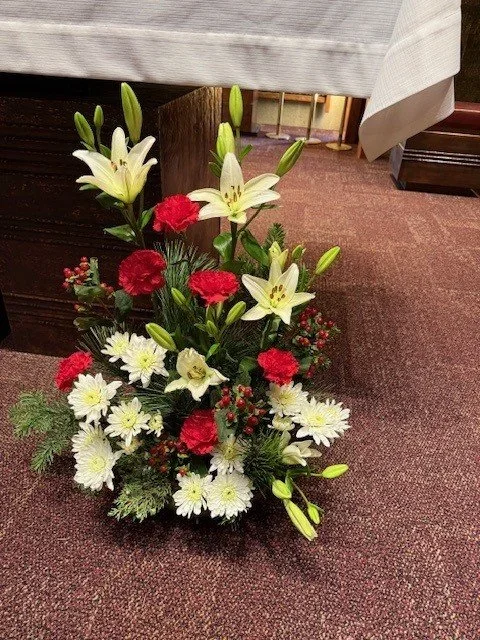
Christmas Day Homily - 2025
On Christmas morning, the Church gives us one of the most beautiful lines in all of Scripture: “The Word became flesh and made its dwelling among us..” Not “visited.” Not “observed from a distance.” God pitched his tent among us. The translation is literally, “TABERNACLED WITH US.”
That image would have meant something very concrete to the people who first heard it. A tent is not a palace. A tent is temporary, vulnerable, and close to the ground. When you pitch a tent, you choose to share the same weather, the same dust, the same dangers as everyone else. And that is exactly what God chose to do.
At Christmas, God does not solve the world’s problems from heaven. He enters them. He pitches his tent in a world that is poor, politically tense, and unsettled. He is born under occupation, into a family with no security and no room at the inn. From the very beginning, God’s tent is set up among people who know anxiety, fear, and uncertainty.
That matters for us today. Because many people come to Christmas tired. Some are worried about the state of the world. Some are anxious about grain and beef prices, health issues, violence, division, or whether compassion still has a place in public life. Some are grieving or carrying private burdens no one else sees. Christmas does not deny any of that. It simply says: God is here.
God pitched his tent not among the powerful, but among ordinary people. Not in safety, but in vulnerability. Not in certainty, but in trust. Which means there is no human experience where God refuses to dwell. No boundary he will not cross. No darkness he will not enter. No life he considers unworthy of his presence.
And this changes how we see God. God is not distant. God is not impatient with our struggles. God does not wait for us to get our lives together before showing up. Christmas proclaims a God who moves in, who stays, who shares our condition from the inside.
It also changes how we see one another.
If God pitched his tent among us, then every human life becomes sacred ground. Every neighbor becomes a place where God is already dwelling. The child, the stranger, the immigrant, the poor, the forgotten—God has chosen to live there. To welcome them is to welcome him. To ignore them is to walk past the tent where God has chosen to stay.
Christmas morning is not about escaping the world for an hour of beauty. It is about seeing the world differently because God is in it. God pitched his tent among us—and he has never taken it down.
So today we rejoice.
Not because life is perfect, but because God is present. Not because all is calm, but because God is close. The Word became flesh and pitched his tent among us—and that means we are never alone.
That is the good news of Christmas. May it fill our hearts and give us hope.
~ Fr. Adam Patras, OSB
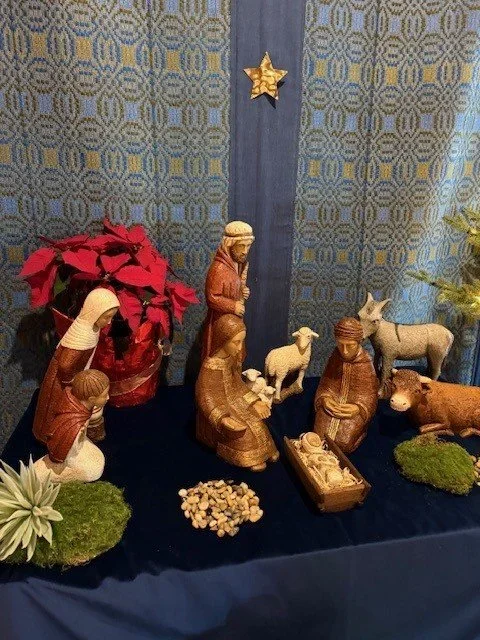
Midnight Mass Homily - 2025
For many years, Fr. Germar and Bro. Andrew, both of blessed memory, would re-entact at our Christmas Eve table the same game. The question went out what song shall we sing? Bro. Andrew would always answer, “Wer Klopfet an!” (Who is knocking!?) Fr. Germar always sang the bass part of the Inn Keeper. The song depicts Joseph and Mary looking for a place to stay for the night, and the Inn keeper asking many questions, and finally turning them away.
Tonight, in the quiet of this holy night, the Church dares to proclaim something astonishing:
“The people who walked in darkness have seen a great light.”
Not armies.
Not policies.
Not power.
But, a little child brings the light.
Tonight, when the world is still, when fears grow louder and divisions seem deeper, God does not shout. God whispers. God comes not as a ruler demanding entry, but as a child needing welcome. The Gospel is familiar: Mary and Joseph arrive in Bethlehem, tired, displaced, and unwanted. “There was no room for them in the inn.” The Son of God is born not in safety, but on the margins, laid in a feeding trough. Before Jesus ever preaches a word, before He heals or teaches or forgives, His very birth makes a statement: God chooses to enter the world as the vulnerable one. And that choice matters, it matters especially now, today!
We live in a time of a lot of unease. Our societal climate is marked by fear anger, and hardened hearts. Few issues reveal this more clearly than immigration. Across our nation and our world, families flee violence, poverty, and desperation. They walk in darkness and are uncertain, exhausted, and afraid. Often, they are met with suspicion, rejection, or indifference. And here is where Christmas speaks, not with slogans, but with a child in a manger. Jesus knows what it is to be displaced. Within days of His birth, He becomes a refugee, fleeing violence, crossing borders, depending on the mercy of others to survive. The holy family is not sheltered by power or privilege. They are protected only by God’s quiet presence and the courage of those willing to help. Christmas does not tell us that every difficult question has an easy answer. But it does tell us something deeper and more demanding: The message is that when God comes to us as a stranger, our response reveals whether we have room for Him. The tragedy of Bethlehem is not that there was no inn. The tragedy is that there was no room. Doors closed. Hearts stayed busy. Fear won out over compassion. But there is good news! God did not, God does not, turn back. God enters anyway! Light shines even when doors are shut.
That is why the angels do not appear to kings or lawmakers, but to shepherds, ordinary people living on the margins. “Do not be afraid, for today a Savior is born for you.” Not for the powerful alone. Not for the comfortable alone. For you. For me. For ALL. The message of the Christmas angel is that God’s answer to a fearful world is not more power, but deeper love. Love begins small. Fragile. Easy to overlook. But once it’s welcomed, it changes everything.
Christmas does not ask us to solve every injustice. It asks us something more personal and more challenging: Will we make room? Will I make room?
Room in our hearts for compassion instead of fear.
Room in our conversations for dignity instead of contempt.
Room in our communities for mercy instead of exclusion.
Every time we make room for the vulnerable, the displaced, the stranger, we make room for Christ Himself. That is what makes Christmas truly hopeful. Darkness does not have the final word. Fear does not get the last say. n a world that often defines worth by wealth, status, or productivity, Christmas proclaims a different truth. The truth that EVERY human life is sacred because God chose to live as one of us.
So tonight, let us kneel, not before an idea, but before a child, a stranger. Let us allow this holy night to soften what has grown hard, to widen what has grown narrow, to remind us that God is still at work, not in noise and outrage, but in quiet acts of welcome and love.
The light that dawned in Bethlehem still shines. And it shines brightest wherever someone decides to make room. That is why we hold these candles tonight! We are children of the good news! We are children of the Light. Will we make room? May we allow the light to transform our hearts and make room.
Merry Christmas.
~ Fr. Adam Patras, OSB
Homily - November 30, 2025
Mt 24:37-44
Is 2:1-5
Rom 13:11-14
focus: The Lord is coming.
function: We are called to be vigilant and prepared.
During their training future airline pilots have to go through practices involving simulators and simulation exercises. One reports: “I had never piloted a plane in my life. So, I was nervous when I took control of a commercial jet in Miami and prepared to fly it to Washington, D.C. The trip was far more eventful than I or my experienced copilot had anticipated. One engine burst into flames. A fuel line sprang a leak. And the plane’s rudder kept sticking.
But the biggest problem came when we prepared to touch down for our landing at Ronald Reagan Washington National Airport. All of a sudden it became obvious that the runway was coming up at too steep an angle. Bam! We hit the runway hard, bounced up, came down and hit it again. My copilot shouted at me to hold on. Then he hit the brakes hard and we came to a screeching halt, just a few feet from disaster.
My heart was pounding. But then I began to relax. I remembered that we had never left Miami. We were in a flight simulator. The experience was so vivid and real that it took me several minutes to get myself back together again.”
Simulators and simulation exercises play an important role in modern life. For example, hospitals simulate disasters to see how doctors, nurses, and equipment react to an overload of patients. Schools simulate fires to find the fastest way to evacuate the students. They all want to be prepared in case of an emergency.
In today’s gospel, Jesus also speaks about preparedness. The Son of Man is going to come suddenly—like the flood in the days of Noah, or like a thief at night. We don’t know the day or the hour of this coming and, therefore, need to be ready always.
The parable that follows in Matthew’s gospel after today’s text, namely that of the faithful or unfaithful servant, gives us a clueas to what this preparedness means. Like the good servant, who distributes to his fellow servants their food allowance at the proper time, so must we live a good and upright life. Then we are ready for the day and the hour of the Lord’s arrival, which, for most of us probably coincides with the hour of our death.
Today’s second reading provides further interpretation. In his letter to the Romans, St. Paul says, “Let us throw off the works of darkness.” He calls upon us to examine ourselves and try to see where works of darkness have found their way into our lives. St. Paul’s message, however, doesn’t stop with moral conversion. “Put on the Lord Jesus Christ,” he says. Let your lives be shaped by the person of Jesus and let your lives be conformed to his.
We stand at the beginning of Advent. Advent is a time of waiting for the arrival of Christ. St. Cyril of Alexandria, in the 5th century, spoke a out the threefold arrival of Christ. Christ arrived in his birth 2000 years ago. With him the great prophecies, like the one by Isaiah that we heard today, have begun to become true. He instructs us in his ways! He IS our peace! He has brought us light and hope! That’s what the Advent candles symbolize. However, we still await his second coming when the fulfillment will be complete. And we wait for his arrival in our own hearts.
My sisters and brothers, the Lord is coming. We are called to be prepared and ready. It isn’t easy in our day and age to live the season of Advent as a time of waiting. Too many bargains attract us at the shopping malls or online; and it makes sense to take advantage of them. Too many gifts for loved ones need to be selected, too many decorations need to go up, too many letters need to be written; these are good things to do. And yet, we would do well to take a quiet hour on occasion during these days, to read some of the Advent liturgy’s Scripture texts, especially the prophets,and to ask ourselves: What do I wait for? What do I long for? For myself—is it total security and being accepted? For our country and our world—is it peace, swords beaten into plowshares, respect for all human life, safety for immigrants? These hopes and longings then we may hold out in prayer to God who alone can fulfill our deepest longings.
The great 11th century theologian, St. Anselm of Canterbury, described Advent waiting for God in this way: “Escape from your everyday busyness for a short while. Be less concerned about your tasks and labors. Make a little time for God and rest a while in Him. … Say [to God] with your whole heart: I seek your face; your face, Lord, I desire.” Such quiet hours prepare us and assist us in letting the light of Christ, the light of the advent candles grow stronger in our hearts and through us in our world. AMEN.
~Fr. Thomas Leitner, OSB

Homily - All Souls - 2025
Joh 6:37-40
Is 25:6.7-9
Phil 3:20-21
focus: We have to pray for our deceased that they may fully arrive home in heaven. At the same time, we are reminded of the shortness of our own lives.
Preschooler Corey’s beloved Grandma had died. He often talked about his Grandma and all the wonderful things she had done with his Grandpa when picked him up from school in the small Iowa town where he lived. And grandpa said: She has gone to heaven. One day, someone else picked Corey up from school. The next day when Grandpa came for him again, he asked, “Where were you yesterday, Grandpa?” “I went to Nebraska, to the grave, to visit Grandma,” he replied. Corey’s response was swift, “Grandpa, I didn’t know heaven is in Nebraska!” When we die, we go to heaven. Corey had learned this.
Today’s Scripture texts expound for us this message of hope.
“I will not reject anyone,” Jesus says in the gospel about those who come to him. Plus, those who look to him, who “see” him and believe in him, already have eternal life in the present. Then in the end, on the last day, he will raise them up and will unite them with himself completely.
We believe that what the prophet Isaiah in today’s first reading announced for the end of time will come true for us in death: the veil that veils all peoples, that is woven over all nations, will be removed. We will be able to see clearly: our own shortcomings and faults, but also our loving and merciful God who receives us into his arms and wipes away all tears from our faces. At first, the confrontation with our own shadow side is painful. This is what the Church’s teaching calls purgatory. It entails purification
Therefore, it is good to pray for our deceased, especially also at the Eucharist.In a verse omitted in today’s first reading, the prophet Isaiah speaks about a great feast of rich food and choice vines that, in the end, God will prepare for us. We believe that in the Eucharist we already have an initial share in this feast. The Eucharist is for us a foretaste of this heavenly banquet.
On a tombstone, I once read this sentence: “Remember me as you pass by. As you are now so once was I. As I am now, one day you’ll be. So stop and say a prayer for me.” Visitors at the cemetery are invited to pray for the deceased, that they may soon reach their true home, heaven.
At the same time, visitors are reminded that their earthly life won’t last forever: “As you are now so once was I. As I am now, one day you’ll be.” There is so much we can marvel about when we look at our human life. We only need to think of the miracle of our body with all the functions it can perform and especially also of our brain!
On the other hand, our human life, all earthly life, is transient. The great temptation for us is to cling to this human life and think that it needs to fulfill all our wishes and desires. St. Paul wrote Christ “will change our lowly body to conform with his glorified Body.” While our physical body is aging and our physical health and strength will eventually decline, we don’t have to be sad.
We know that a greater and fuller life, our true home, awaits us in heaven.
Dear sisters and brothers in the Lord, we may trust that our deceased are with God. At the same time, we are reminded today of the shortness of our own lives.
It would be a good idea to spend some time today remembering our deceased family members, brother monks, parishioners, oblates, friends and acquaintances. It is good to go to the cemetery and visit some of their graves. We believe, trusting in God’s mercy, that they are already close to God. Certainly, we must pray for them that God may take them to himself.
On the other hand, we may ask them, because of their nearness to God, for their intercession, that we may become able to accept the unavoidable limitations and the transience of our earthly life, which we eventually will lose.
If we live with the awareness that one day we will die, if we keep death before our eyes daily, as St. Benedict suggests, we can live to the fullest every day. Then little Corey’s comment will come true for us: Heaven [a foretaste of heaven] is possible in the present, here in Nebraska.
And we live in hope, in the expectation of, and in readiness for God’s boundless love, peace and joy that we, like so many who have gone before us, will experience one day in fullness in heaven.
AMEN.
~ Fr. Thomas Leitner, OSB
EULOGY - Brother Andrew Fuller, OSB
Recently, Brother Andrew and I were talking about the first time we encountered each other. I had come home for a visit from the seminary, and he had just moved into the monastery to begin his monastic way. I had been the “only child” of eight German monks for about ten years. Being the first American, I had enjoyed something of a status. Some other American men had come and gone pretty quickly. And now, here was this person, this old guy (he was 11 years older than me) with that sassy Boston mouth, using swear words in our kitchen. I was not impressed!
He would forever remind me of my first response to him, even up until his last days when attention turned to his quickly deteriorating health.
Brother Andrew was a person you either loved or did not care for. The attendance at his viewings and at this celebration today are a testament to the fact that mostly, he was loved, despite his foibles. And the stories told at the viewings are a witness to the fact that the goodness in his life, being a person of great love that, the goodness seems to have outweighed the rest.
In the gospel today the Lord tells us that we know the way. A couple people in the last days expressed to me a doubt that Br. Andrew knew the way.
Yes, Brother was not perfect (who of us is), he could be quite judgie himself. Often, he did not do the things he was asked to do completely, and He had the mouth of a sailor.
One day he came to me very excited, “Adam, I just read an article that said that people who cuss are considered intelligent. I must be a bleepin’ genius!”
Br. Andrew could be quite dramatic, even about the smallest things, and yet he was a seeker. If someone were to ask me what Brother’s spirituality was I would have to say, a sometime Jew, often Buddhist, naturalist, Native American, feminist, Franciscan, Protestant, but always Ukrainian Orthodox Catholic.
Of late, he was fond of saying “we are not real monks,” but was reluctant, when challenged, to take the lead and show us the error of our ways. In my training as a spiritual director and as a priest, and in my 60 years of life, as one whose earliest memories are spiritual memories, I would say to those who doubt that Andrew did not know the way—this runs counter to my experience of God.
Before he was afflicted with cancer, Br. Andrew was always one of the first men in the chapel. He was a practiced pray-er of the Jesus prayer, and was very interested in most, if not all, things spiritual. “In my father’s house, there are many dwellings.” As I meditated on this Gospel and Br. Andrew’s life, it seemed to me that these many dwellings can be a metaphor for the way or ways to God. It was Pope Benedict who said, “The ways to God are as numerous as the types of people there are”. I would dare to say, as numerous as the many dwellings prepared.
The problem with organized religion often is that it wants to lay everything out in a straight line, in perfect boxes, in set ways. If you are not this, then you are out.
But a person with the mouth of a sailor might enter paradise before someone who prays the rosary every day, who judges others. In my father’s house, there are many dwellings, dwellings even for a sometime Jew, often Buddhist, naturalist, Native American, feminist, Franciscan, Protestant, but always Ukrainian Orthodox Catholic. And perhaps, just perhaps, even for the just plain old Roman Catholics!
Today, we give thanks for the life of Br. Andrew. We are very grateful for the care he received at the Hematology and Oncology Unit in Columbus, especially from Dr. Reno and the entire staff. They told us that in the seven and a half years of treatment there, they often sat Brother next to patients who were struggling, especially the younger men. That patients would jockey to sit next to the “mouthy monk”.
We are grateful to the Schuyler Rescue Unit who quickly, carefully, and skillfully responded to our call for help on the night of Friday, September 26. We are grateful to the staff at Immanuel CHI, and to the staff of CHI Bergan Mercy Cardiac Care Unit who lovingly cared for him until the end came, and to his many friends who came to see him in his last days. A special thanks to his family, who were a strong support in helping Andrew make decisions for his health and finally his death. To our coworkers, oblates, and all of you, I want to express our gratitude for your kind words, stories, and prayers.
For him, the struggle is now over; for him, it is a relief.
May the light of love that burns away every fault, may the king of love that reigns in all our hearts, grant him his dwelling place and give him peace and rest.
~Fr. Adam Patras, OSB
Homily, Sunday, September 7, 2025
Focus: Following Jesus means making good decisions day by day that orient us ever more clearly toward him. His promise: life in fullness.
Often we see commercials in the media with enticing announcements of something we can have for “free.” Some of us get burnt—we do what the ad asks and find out the “free” thing actually costs quite a lot. In this way a person learns quickly to read the fine print of such offers because the fine print can become the stumbling stone.
In today’s gospel, Jesus speaks very plainly with us and hides nothing. He bluntly challenges those who are with him to take up the demands of discipleship with eyes wide open. Jesus clearly spells out the fine print in large letters, so to speak: Disciples must put Jesus ahead of their families. The word ‘hate’ is hyperbolic; we understand what Jesus means when we read Matthew’s version of this verse: “Whoever loves father or mother more than me is not worthy of me” (Mt 10:37). The disciples’ families and friends (in person or virtual) must not keep us from following him, nor must possessions be in the way; nor even concern for their own lives.
This gospel passage is part of a larger section in Luke that extends over ten chapters: the narrative of Jesus’ journey to Jerusalem following his ministry in Galilee. Jerusalem is the city of Jesus’ destiny, where his suffering, death, resurrection, and ascension are going to take place. There salvation is being accomplished and from there, guided by the Holy Spirit, the proclamation of God’s saving word is to go forth. During the course of his journey to Jerusalem, Jesus is preparing those around him for the role they will play later as his missionary disciples
Great crowds are traveling with him, we hear. Jesus wants everybody to know that following him isn’t a walk in the park. His listeners are meant to “calculate the cost” of discipleship. Jesus’ message is a pretty challenging one: “If our absolute priority isn’t Jesus and his mission, then we “cannot be [his] disciple(s).” And: Following him includes carrying one’s cross.
Material things, the respect and praise of people and power and influence over others are not bad in themselves. They are God’s good gifts and they can be used for the glory of God. The problem comes in when God’s gifts become possessions. They are mine; I hold on to them.
God gives us wisdom and sends the Holy Spirit from on high, so today’s first reading tells us. The Holy Spirit shows us how to use God’s gifts aright. Today’s gospel, therefore, is an invitation to us to practice discernment: Is a thought that we entertain, a word that we speak and an action that we take the work of the Holy Spirit in us or are we allowing other spirits that aren’t the Holy Spirit to gain influence over us?
Dear sisters and brothers in the Lord, Following Jesus means making good decisions day by day that orient us ever more clearly toward him. His promise is that we will receive a hundred times more than what we have given up and, even on this earth, life in fullness.
One good way of keeping track of our everyday decision making is the Examination of Consciousness. Many people do it at the end of the day. I do it in the evening, too. I first ask God for clarity and understanding in regard of what happened in my life and in me during this past day. Then I review my day in thanksgiving. I think about the day in terms of how it was a gift. I thank God for my existence, my work, my relationships, for the food that nourishes me … and even for difficult things
that happened. I review my feelings that surface in the replay of the past day. Our feelings, positive and negative, painful and pleasing,are the liveliest index of what is going on in our lives. Then I choose one of those feelings (positive or negative) and use it as a starting point for prayer, for praise, petition, contrition or a cry for help. Finally I look toward tomorrow. I think of the tasks, meetings and appointments of the next day. Which feelings surface? I turn them into spontaneous prayer.
I conclude with the Lord’s Prayer. This method which comes from St. Ignatius of Loyola, can help us to determine when in the course of our day we fell victim to false promises and when we responded to those of Jesus.
I wish all of us and pray that as we return back into the ordinary routine of life this fall, we may do so with attentiveness toward what’s happening around us and in us and with great trust that the Holy Spirit whom Jesus has sent uswil l enlighten, guide and strengthen us on all our ways. AMEN.
~Fr. Thomas Leitner, OSB